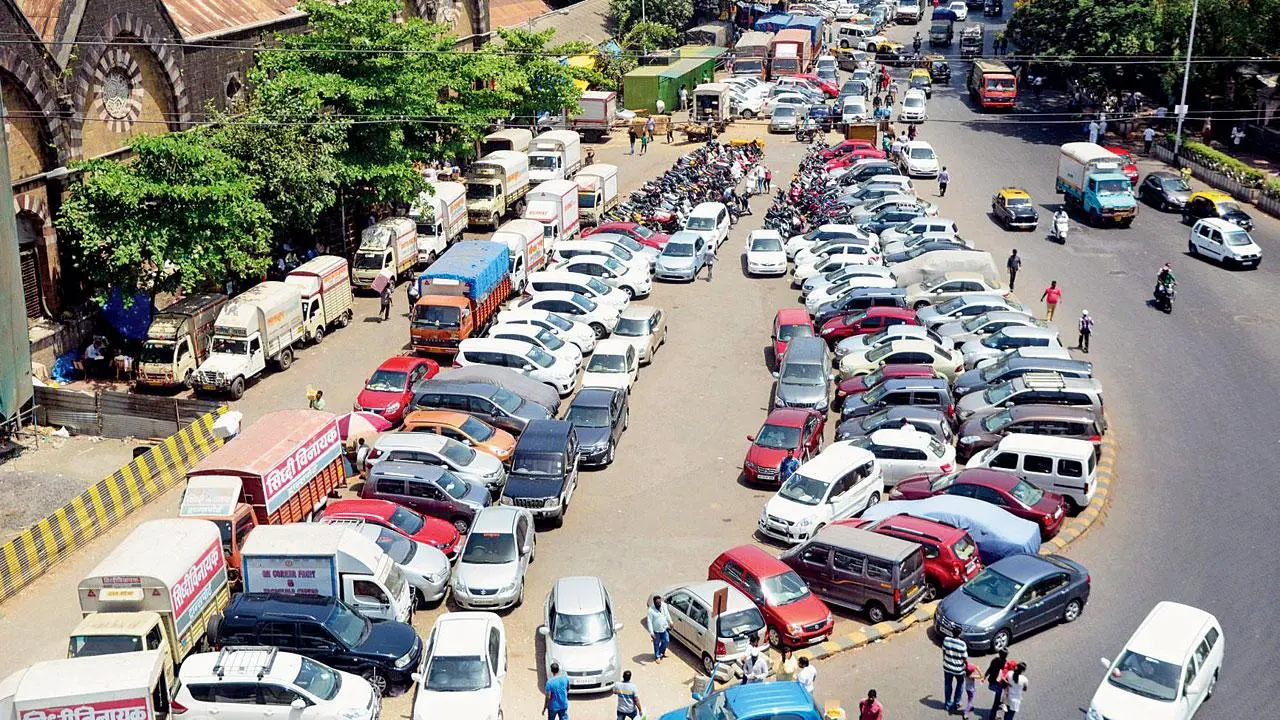
2017 marked an incredible surge of overpopulation in India which led to parking problems on a daily basis causing congestion and chaos, that one couldn't imagine. In spite, doubling the staff of traffic officials, they weren't able to control the rising traffic violence caused due to overcrowding and illegal parking.
2017 marked an incredible surge of overpopulation in India which led to parking problems on a daily basis causing congestion and chaos, that one couldn't imagine. In spite, doubling the staff of traffic officials, they weren't able to control the rising traffic violence caused due to overcrowding and illegal parking.
Understanding current
problem space
Understanding current
problem space
We conducted observations, semi-structured interviews and went on field visits to famous parking bays of Mumbai city to understand the problem space. All three of the team members visited different public parking places to get insights on the level of mayhem caused everyday. India being a developing nation, never thought of adopting a "smart parking system" till date and the concept is fairly new, even in 2026. Conduction of this project is a preliminary effort to propel more digitalisation and implementation of smart systems to enhance human parking experiences.
We conducted observations, semi-structured interviews and went on field visits to famous parking bays of Mumbai city to understand the problem space. All three of the team members visited different public parking places to get insights on the level of mayhem caused everyday. India being a developing nation, never thought of adopting a "smart parking system" till date and the concept is fairly new, even in 2026. Conduction of this project is a preliminary effort to propel more digitalisation and implementation of smart systems to enhance human parking experiences.
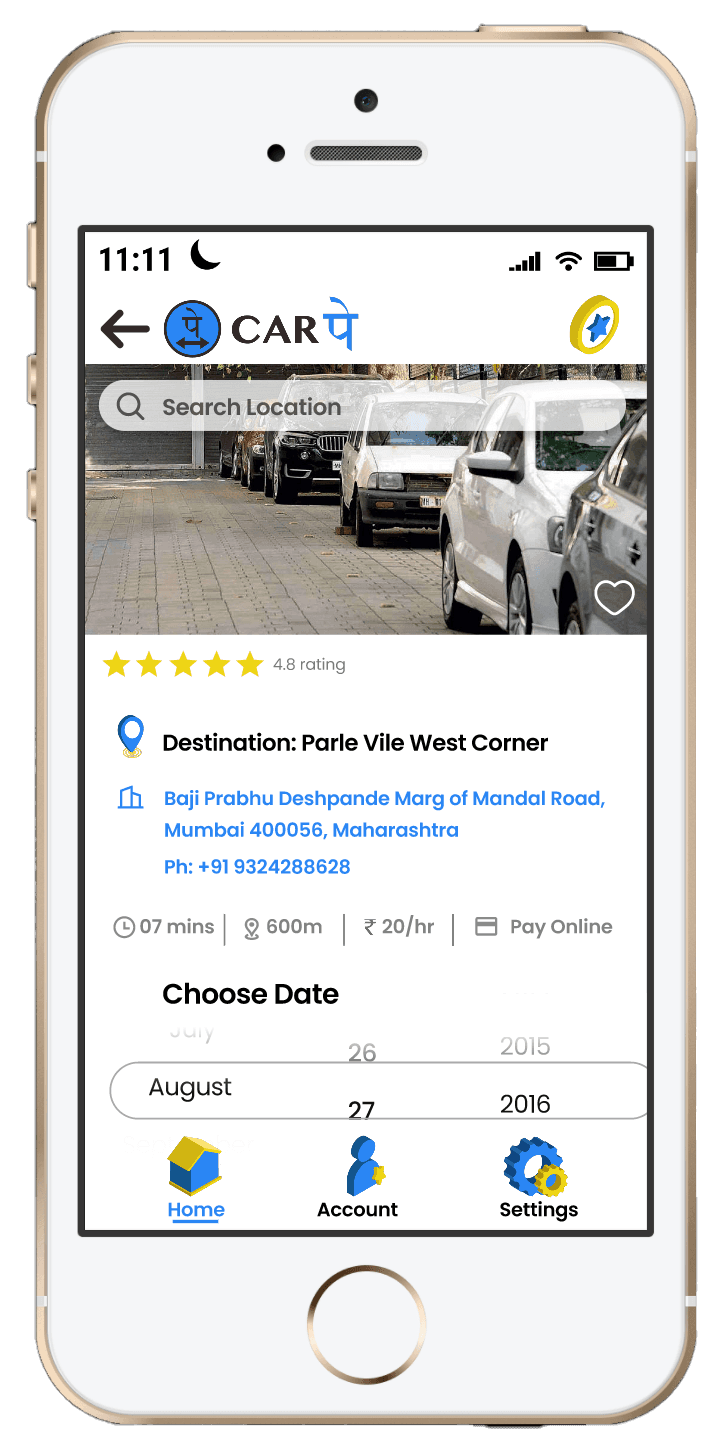
Enter basic details
User is redirected to online booking by filling relevant information in order to book a particular slot.
Enter basic details
User is redirected to online booking by filling relevant information in order to book a particular slot.
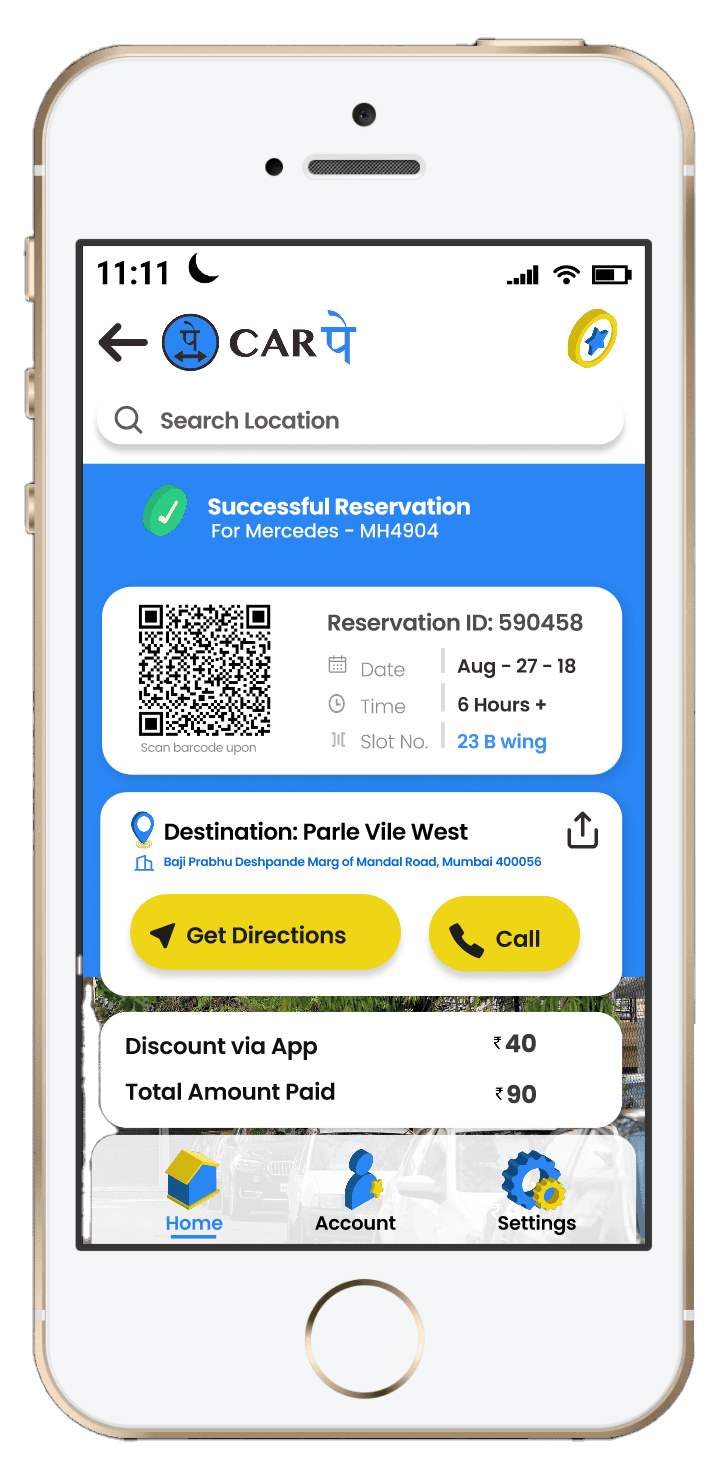
Get an E-ticket
User is redirected to online booking to encourage more users, only a minimal fee is paid online, the user will be presented with an e-ticket with all the details including parking spot location, directions and admin's phone number.
Get an E-ticket
User is redirected to online booking to encourage more users, only a minimal fee is paid online, the user will be presented with an e-ticket with all the details including parking spot location, directions and admin's phone number.

Interactive 3D map
Users can choose a location with visual ease the user can navigate available spaces on the live map and reserve a slot before making the payment. Hence, the topography of available spaces will be mapped meticulously from a top perspective and made available to users as options.
Interactive 3D map
Users can choose a location with visual ease the user can navigate available spaces on the live map and reserve a slot before making the payment. Hence, the topography of available spaces will be mapped meticulously from a top perspective and made available to users as options.
Research
Interviews
Field visits
Walkthroughs
Research
Interviews
Field visits
Walkthroughs
Synthesis
Task analysis
Gathering datasets
Online resources
Synthesis
Task analysis
Gathering datasets
Online resources
Brainstorming
White boarding
Group ideation
Pen/paper
Balsamiq mocks
Brainstorming
White boarding
Group ideation
Pen/paper
Balsamiq mocks
Prototyping
Reiterations
Space mapping
Clearing tech jargon
Prototyping
Reiterations
Space mapping
Clearing tech jargon
Evaluation
Cognitive analysis
Benchmark tasks
SUS scale
Post-task feedback
Evaluation
Cognitive analysis
Benchmark tasks
SUS scale
Post-task feedback
Documentation
Report
Presentation
Showing process
Entries
Documentation
Report
Presentation
Showing process
Entries
My UX Process
My UX Process
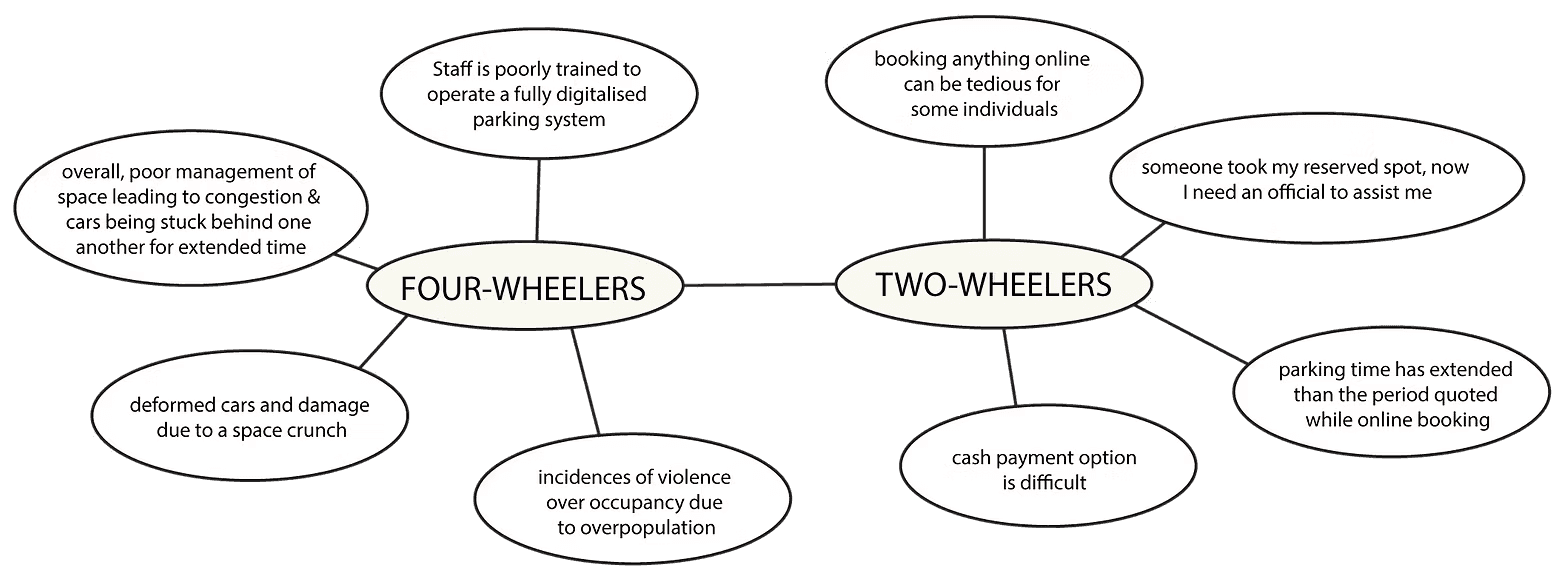
Insights Formed
Insights Formed
Derived Persona
What's the parking
process really like ?
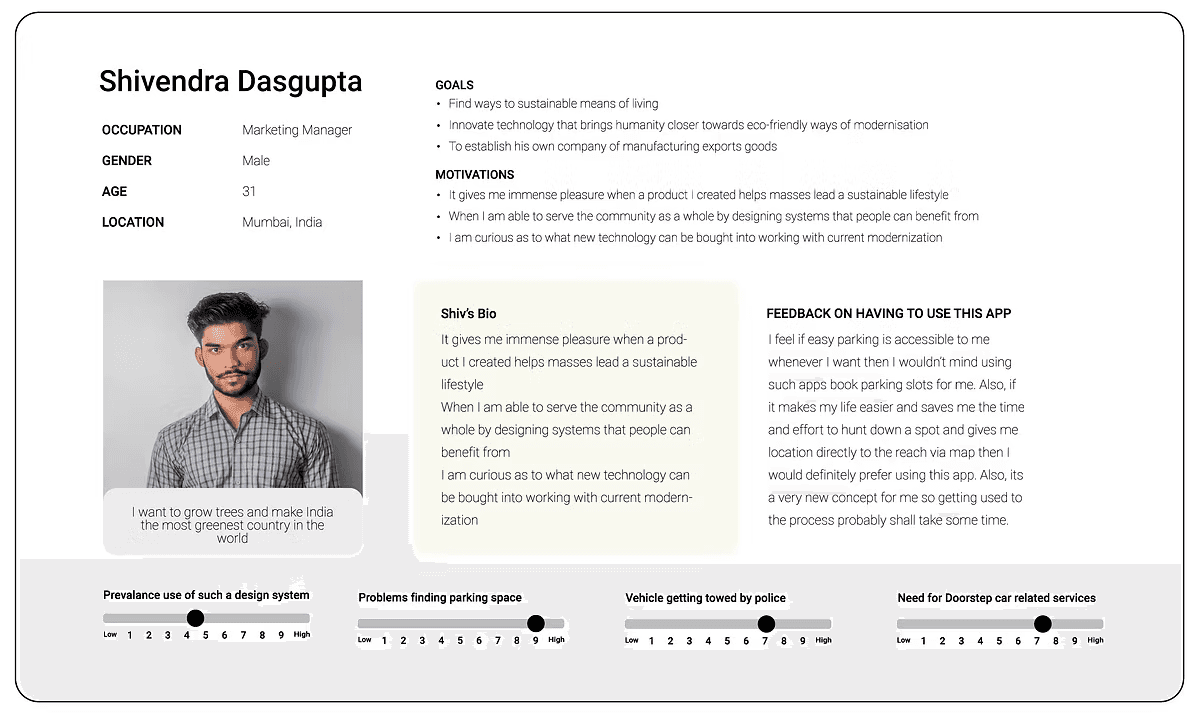
We wanted to understand how users go about when booking a parking slot online and the different decisions made along the way. We conducted a task analysis and then created a journey map.
Finding key user needs
Finding key user needs

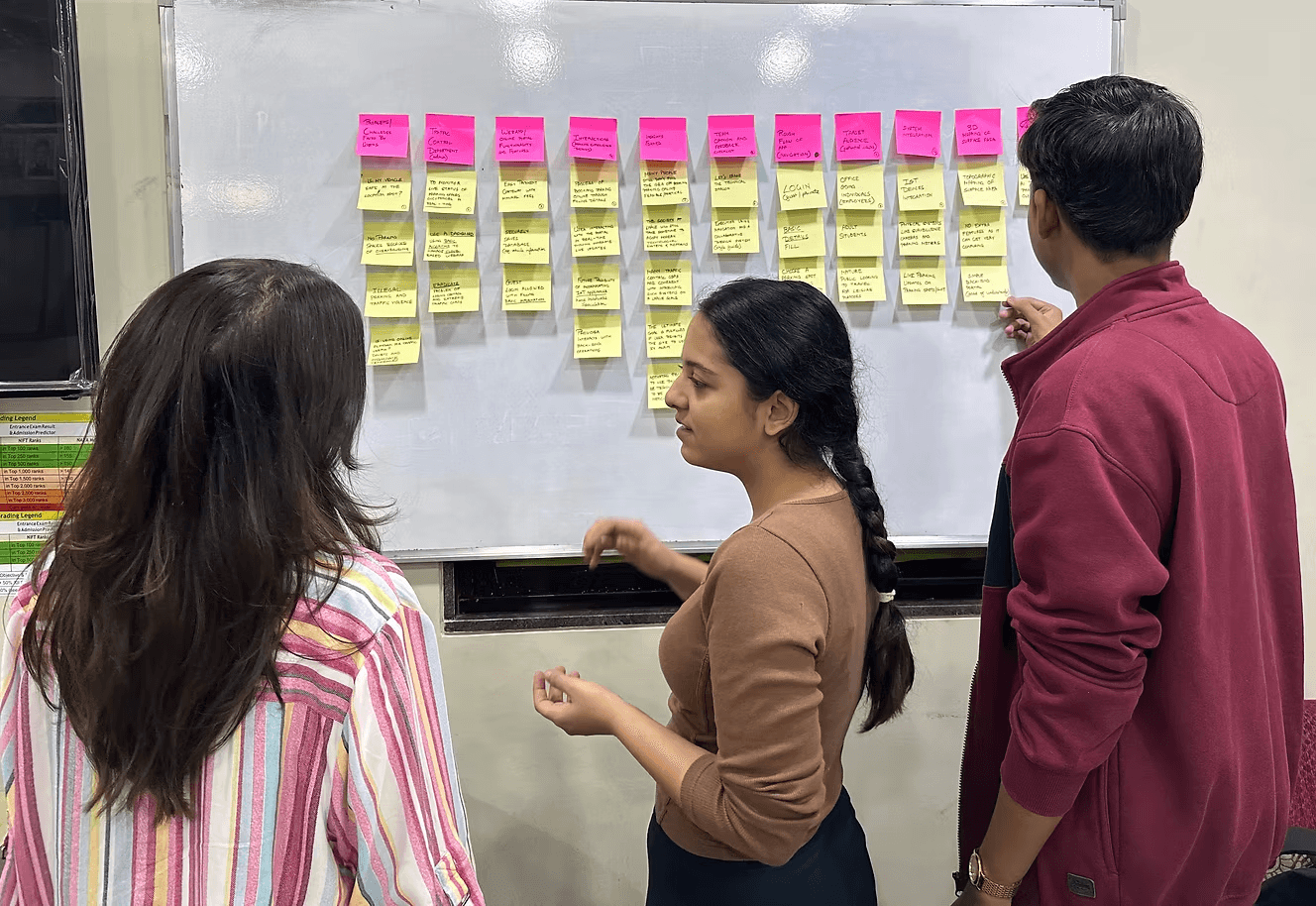
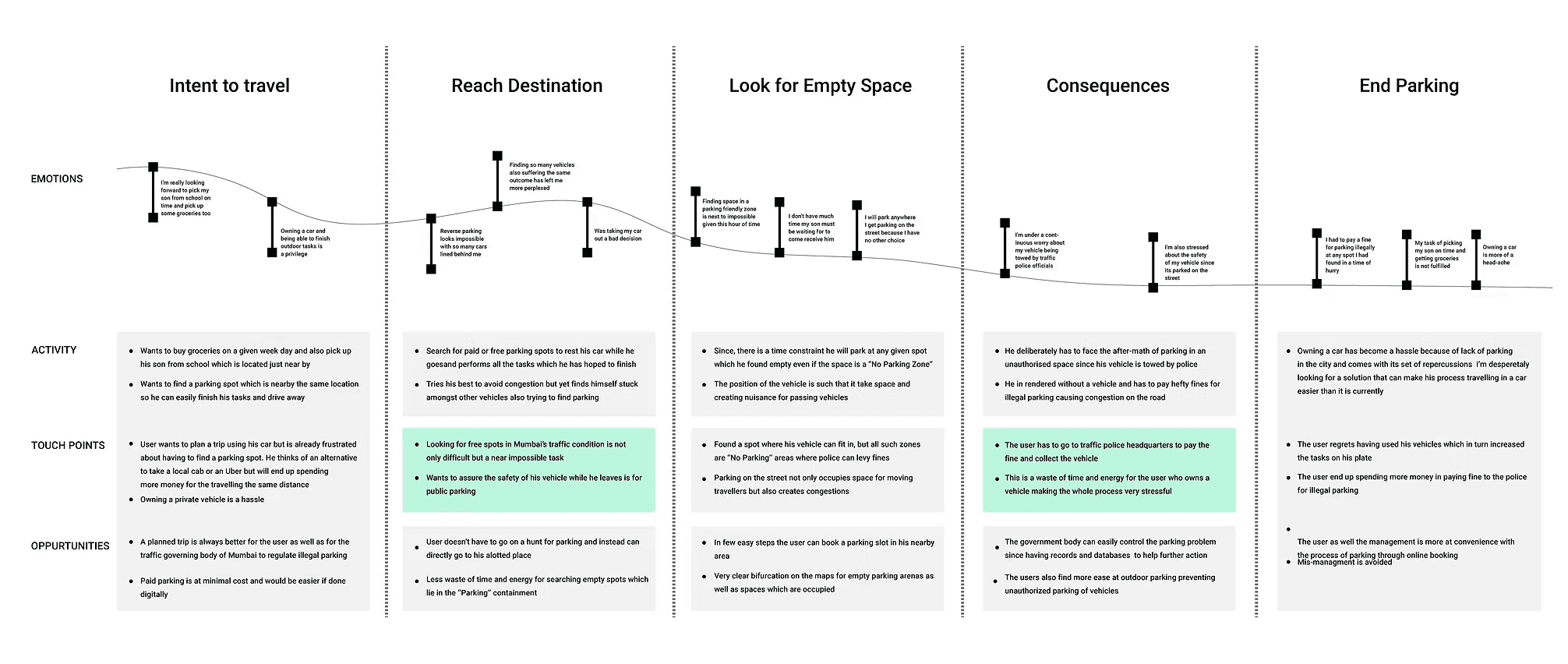
We analysed our separate notes from all the previous formative research on an affinity diagram. This helped us segregate our findings to identify key user needs.
I don't want to wait in long congestion queues for a simple parking
I'm having trouble in locating my car since so much haphazard vehicle parking
I wish there is a quicker way to reach my destination to straight away park my car
We analysed our separate notes from all the previous formative research on an affinity diagram. This helped us segregate our findings to identify key user needs.
I don't want to wait in long congestion queues for a simple parking
I'm having trouble in locating my car since so much haphazard vehicle parking
I wish there is a quicker way to reach my destination to straight away park my car
Brainstorming
Brainstorming
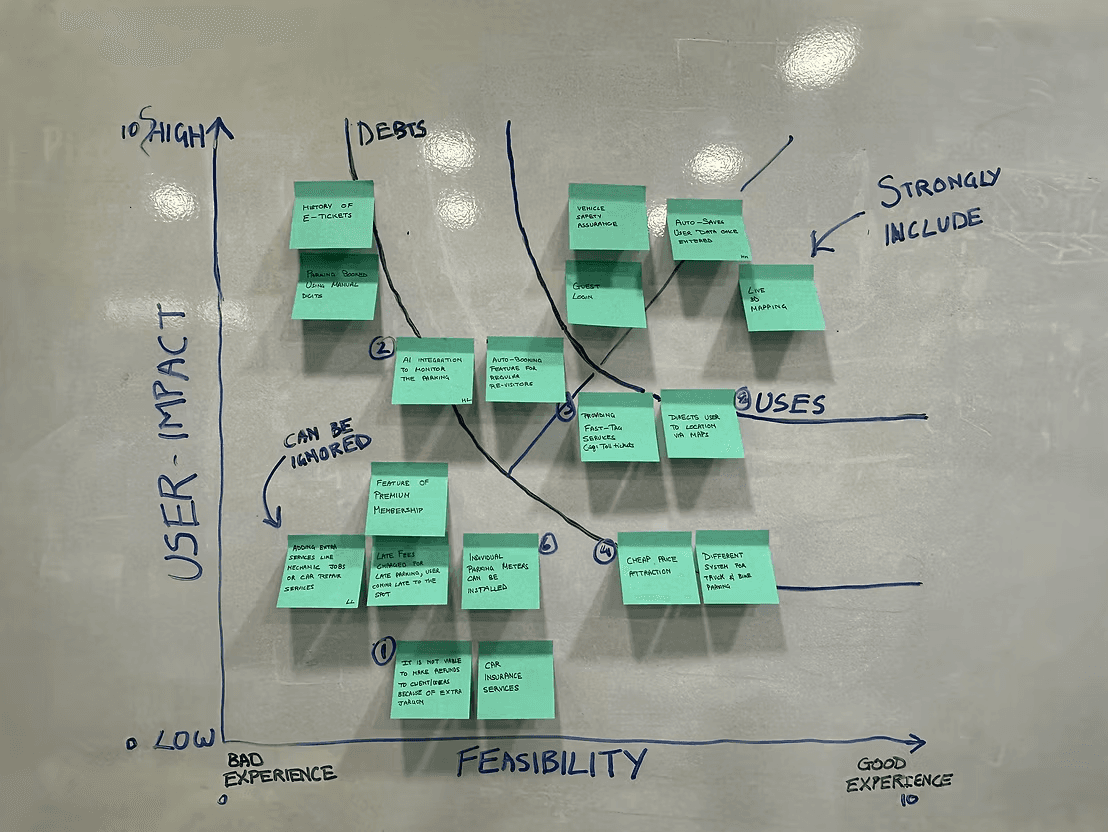
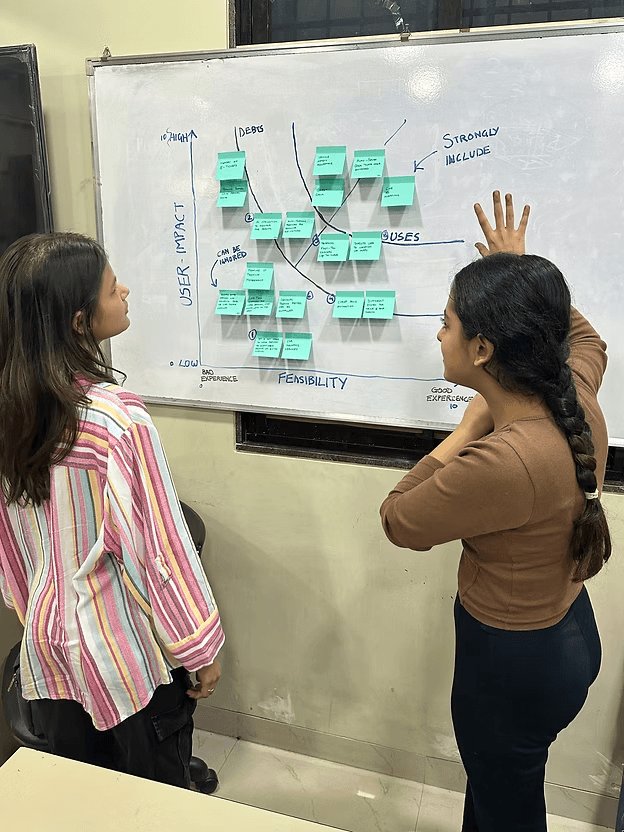
We were struggling with how to narrow down details for end-to-end process of parking experience. We wanted to eliminate unpredictability that one faces while online booking. That's when I worked on the feasibility vs user-impact chart which helped us derive conclusions for the next steps. We wanted a way where we could maximise the benefits for the user but also keep it very simple for the providers to encourage them to adopt the system.
We were struggling with how to narrow down details for end-to-end process of parking experience. We wanted to eliminate unpredictability that one faces while online booking. That's when I worked on the feasibility vs user-impact chart which helped us derive conclusions for the next steps. We wanted a way where we could maximise the benefits for the user but also keep it very simple for the providers to encourage them to adopt the system.
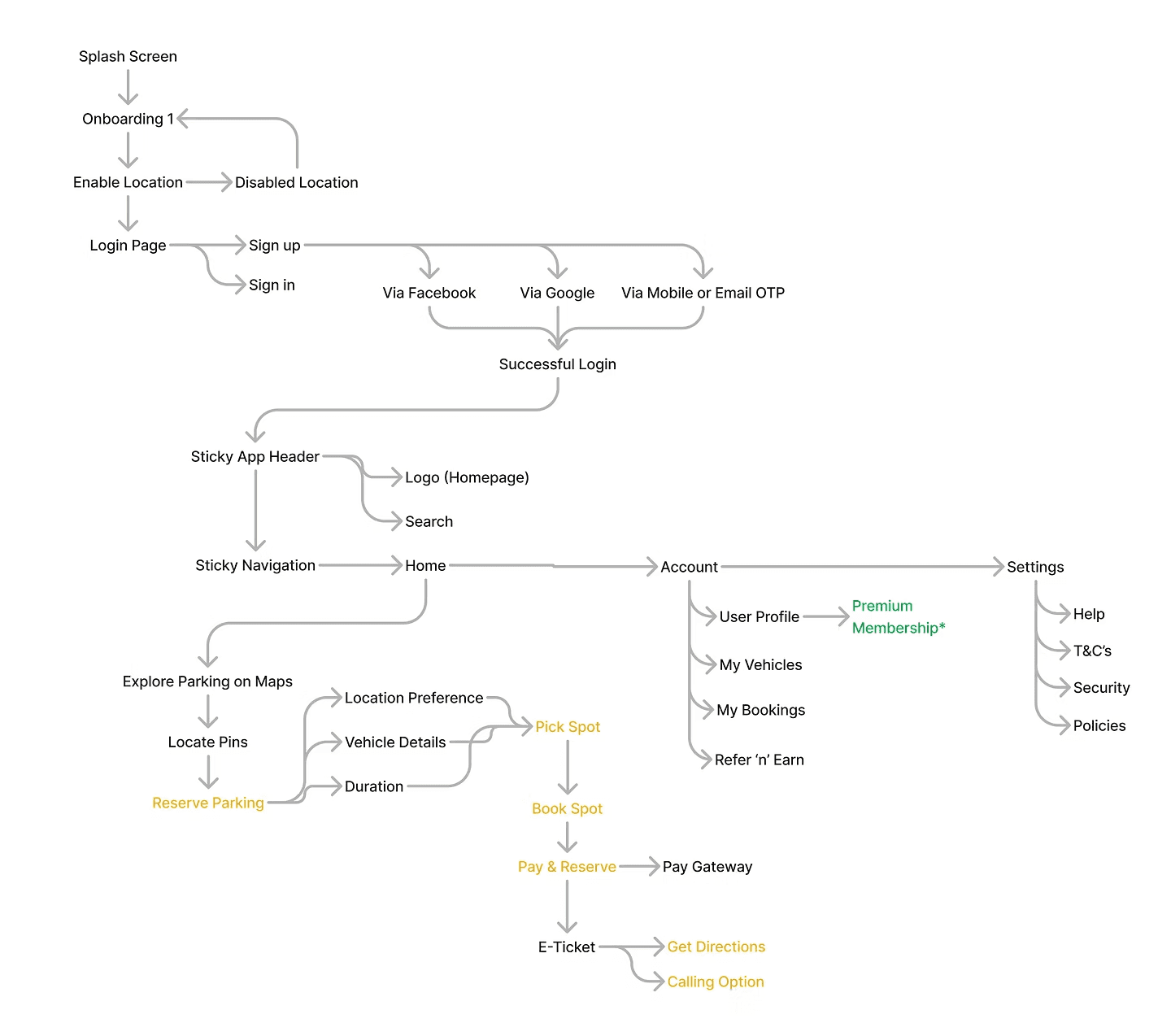
Information Architecture
Information Architecture
Visceral Design
Visceral Design
Designs that follow mental models, for people to instinctively and intuitively navigate through the app making parking available through least number of taps (Note: that people in the 21st century have a good amount of experience with operating mobile apps). CarPay's primary iconography consists of "3D graphic icons" inspired by historically carved road-signages to imbibe a welcoming and an understandable appeal. The app also uses a combination of contrasting colours "yellow and blue" signifying the "availability of parking spaces" while evoking a sense of safety and harmony at the same time. The type family used is "Poppins" for clear visibility along with writing its UX copy.
Designs that follow mental models, for people to instinctively and intuitively navigate through the app making parking available through least number of taps (Note: that people in the 21st century have a good amount of experience with operating mobile apps). CarPay's primary iconography consists of "3D graphic icons" inspired by historically carved road-signages to imbibe a welcoming and an understandable appeal. The app also uses a combination of contrasting colours "yellow and blue" signifying the "availability of parking spaces" while evoking a sense of safety and harmony at the same time. The type family used is "Poppins" for clear visibility along with writing its UX copy.


Reflective Design
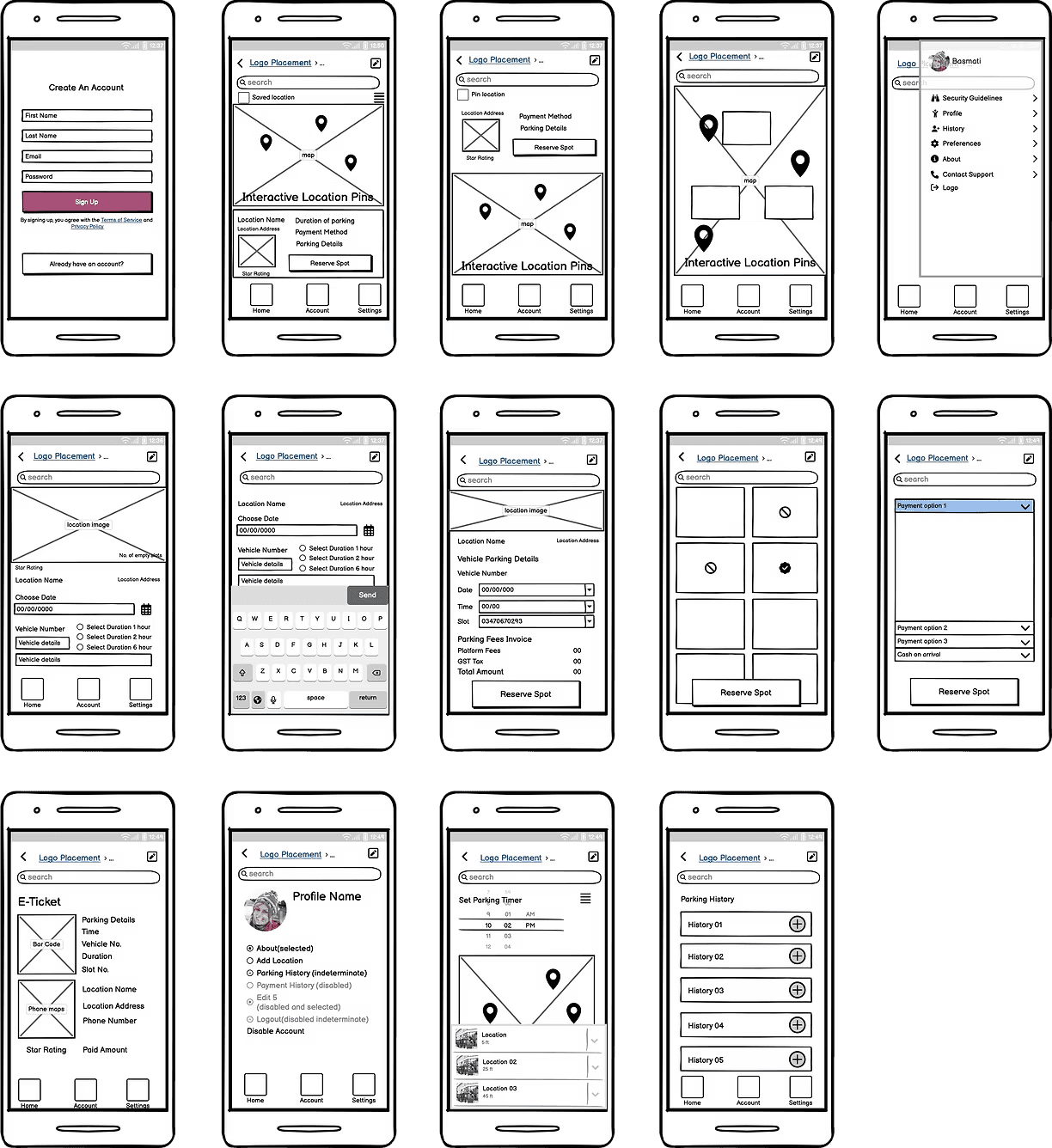
When people reflect to the parking booking experience they must feel its very 'simple' or 'easy' and hence come back to use the app again, providing the comfort and direction for daily commuters and hence solving the issue of parking chaos at large and building the revisitors database. Balsamiq low-fi wireframes were explored to guide us ahead.
Hi-fi Supporting Screens
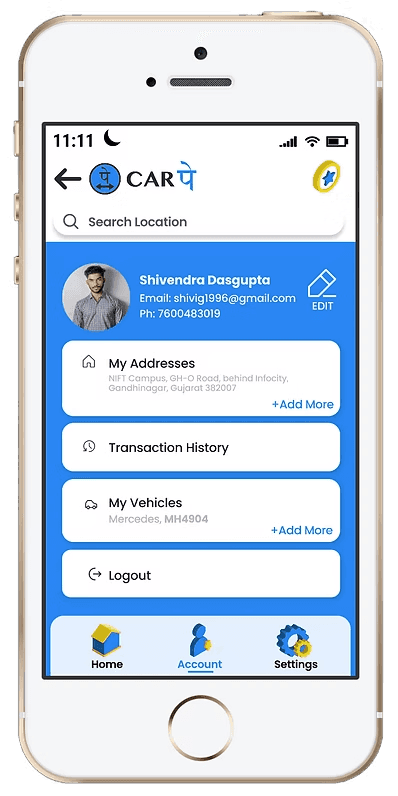
These are some of the key design decisions I lead based mostly on the data we gathered and believing my gut as a problem solver
My Profile
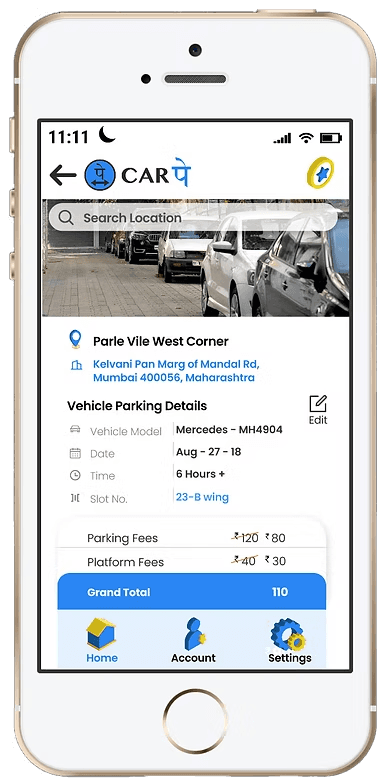
Order Confirmation
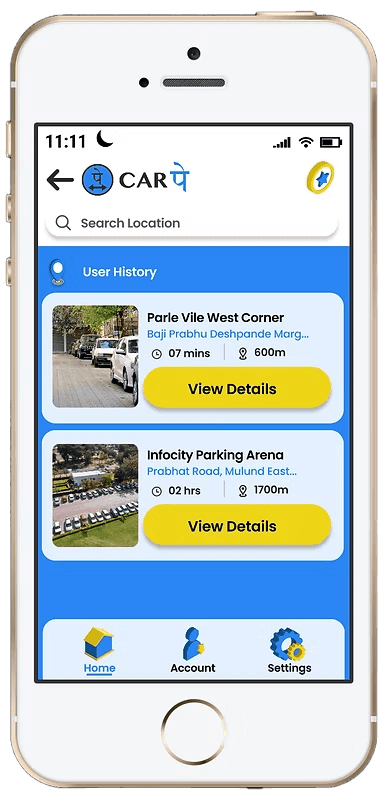
Account History
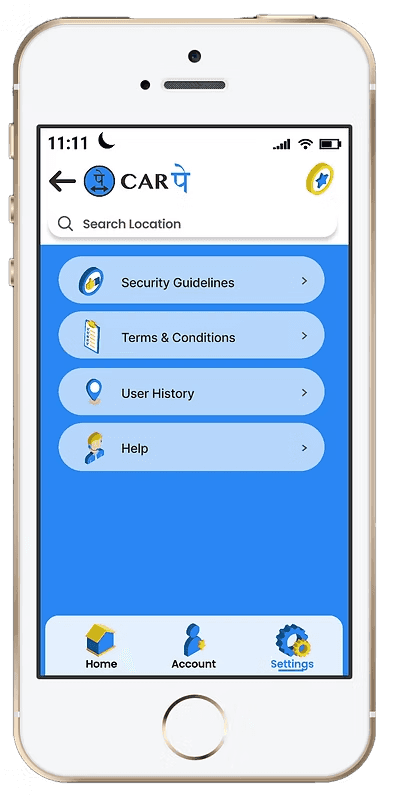
Settings
App Highlights
Driving Assistance helps the user to accurately reach the parking destination with the help of maps to locate a specific spot
Guest Login allowed for convenience
Saved History has a past archive of exact location where the vehicle was parked along with its directions. The app also saves other data such as time, vehicle model, mode of transaction, etc for users to retrace their records easily
Parallel Comparison of parking spaces along with its price and other details
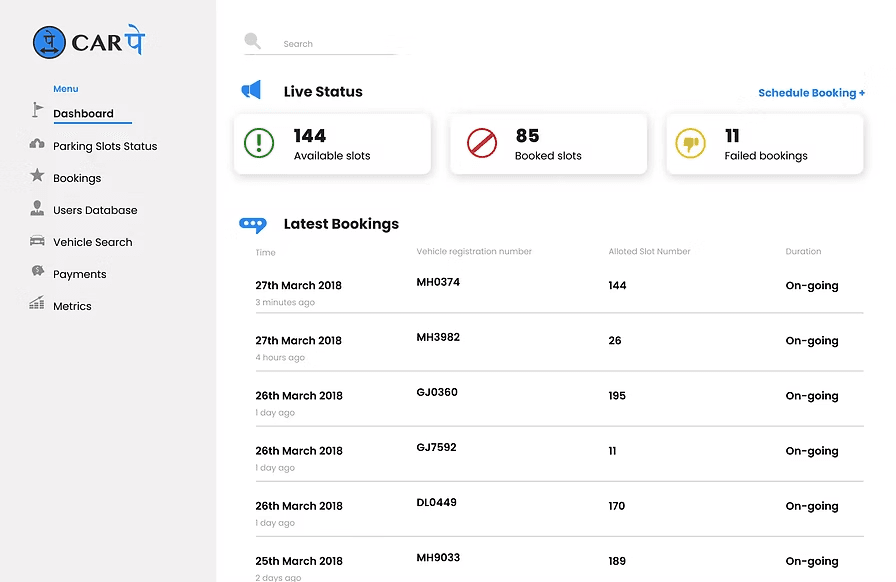
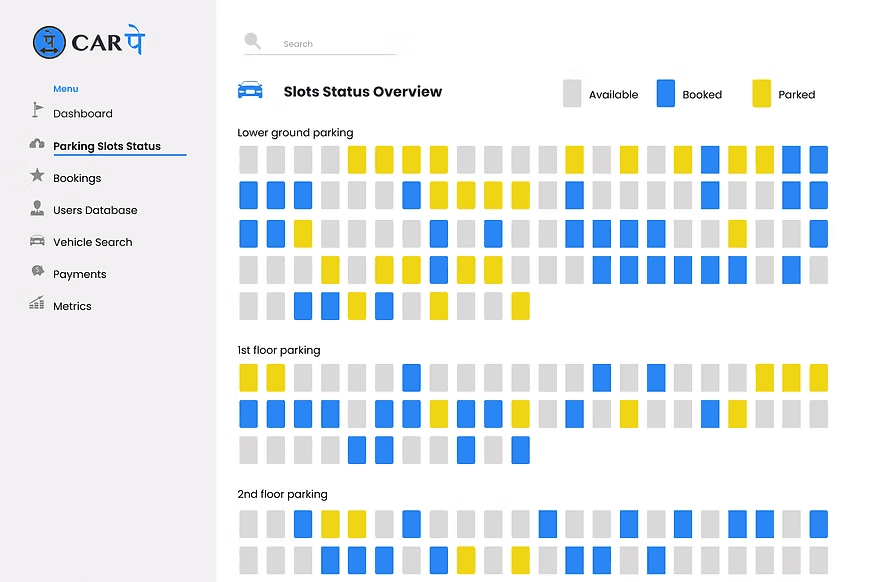
CarPay's centralised management dashboard gives a comprehensive overview of all the parking lots that have been mapped under CarPay's supervision. Basic algorithm sorts the data entries by specifics such as relevance, location, driver details, vehicle model, payments, etc. The design simplicity, is intended to optimise all back - end operations,
Interface for Admin Panel
Despite my limited experience, this app was first designed to be fully digital, however, with my online research I deduced that monitoring can be made much stronger by embedding cameras, ultrasonic sensors and parking meters to track the timely activity of the user in real-time occupancy by the admin panel thus, full-proofing the "smart parking system design" (eg: integration of IoT-based appliance)
Hardware Speculation
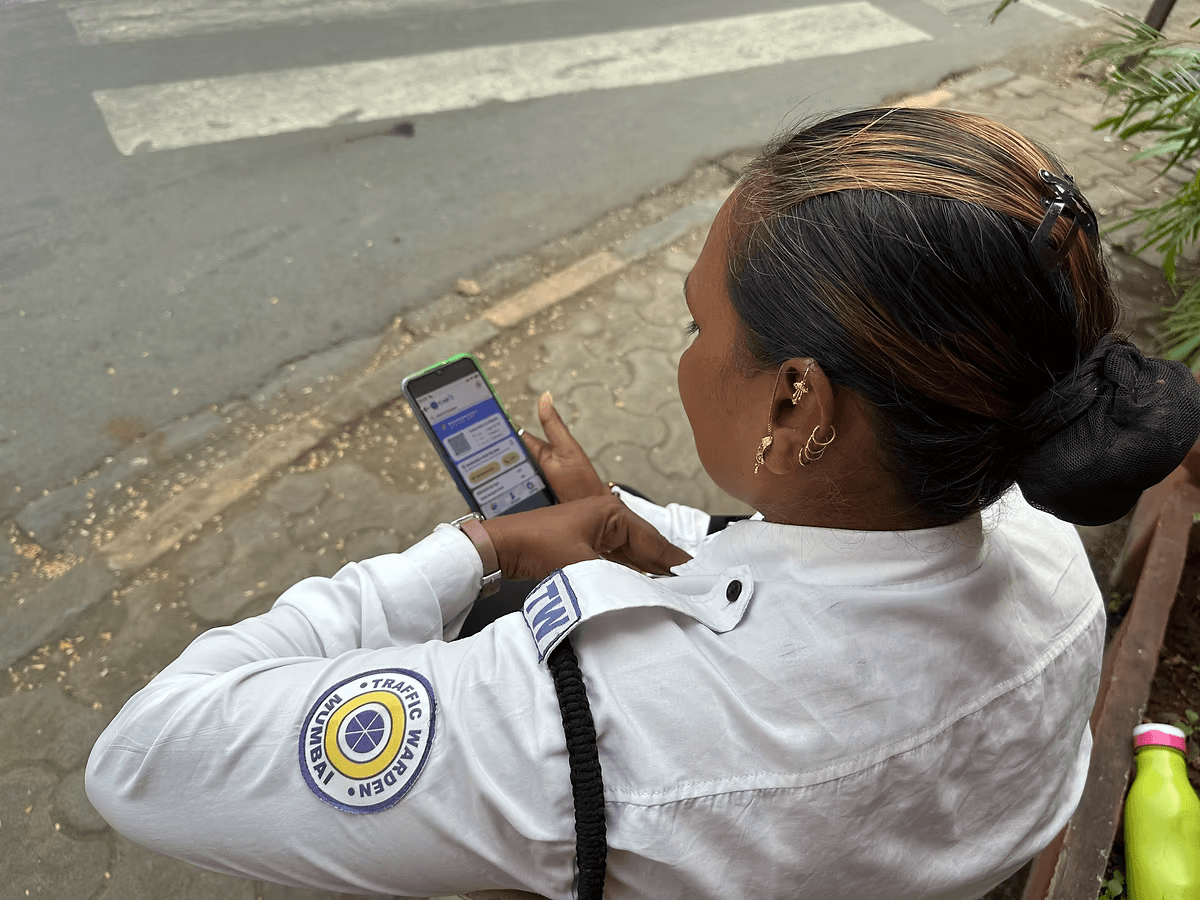
Besides learning and iterating on my own, we also demonstrated the basic use of the app and got feedback from the "Traffic law reinforcement structure of MAH-Police, Mumbai, India" Some even suggested for a kiosk set-up at public hotspots to digitalise parking whereas, many agreed that an app is more convenient as waiting in kiosk queues can be very time consuming. We were reassured from our target users and experts that using smartphones to pre-book slots can ease the overcrowding situation during parking.
Design Direction
For the initial functionality test, we used a combination of expert and user testing in order to test the functioning of our application design. We started with a list of interview questions for our potential users to probe deeper into the pain points and ended the design working with a post-task questionnaire to get an in-depth feedback on the design solution. An attempt to investigate the usability/practicality of the app, in order to get different types of feedback in terms of both quantitative and qualitative measures.
Feedback & Constructive
Criticism
User Interviewed: 5
Expert Review: 1
SUS score: 75
Preceding & Succeeding
Changes
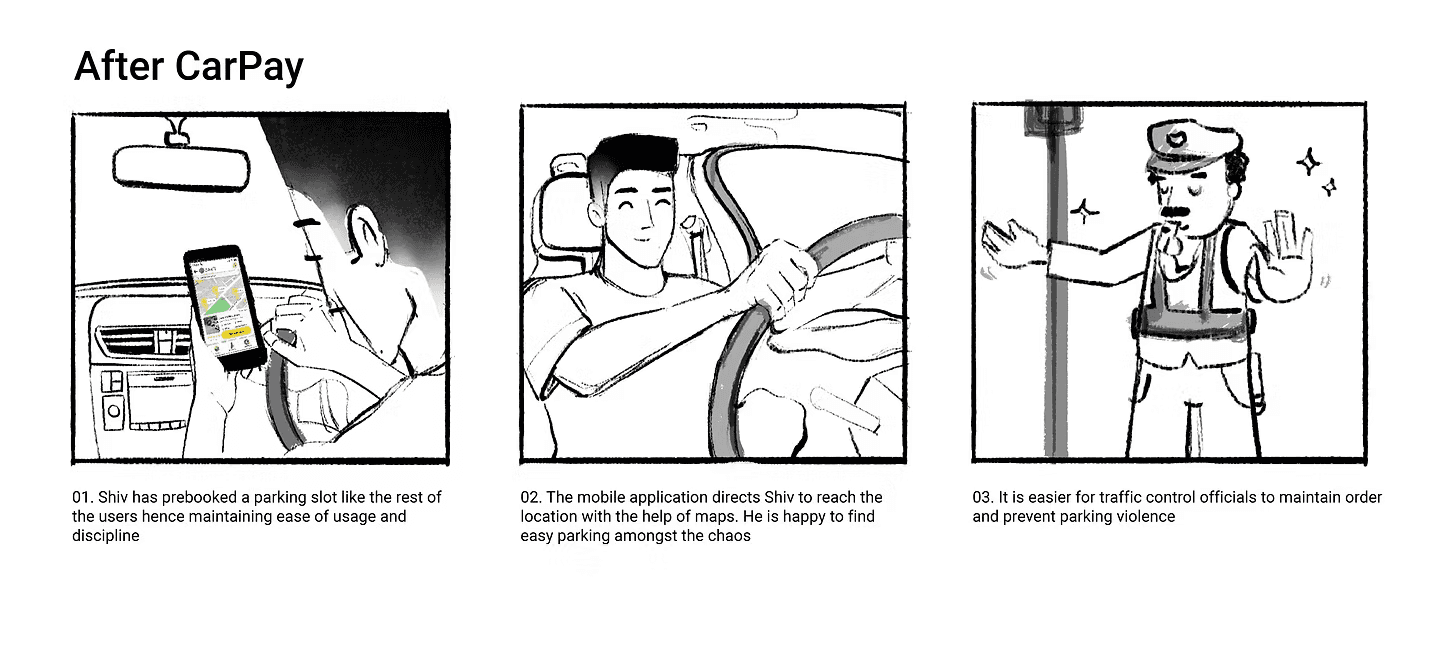
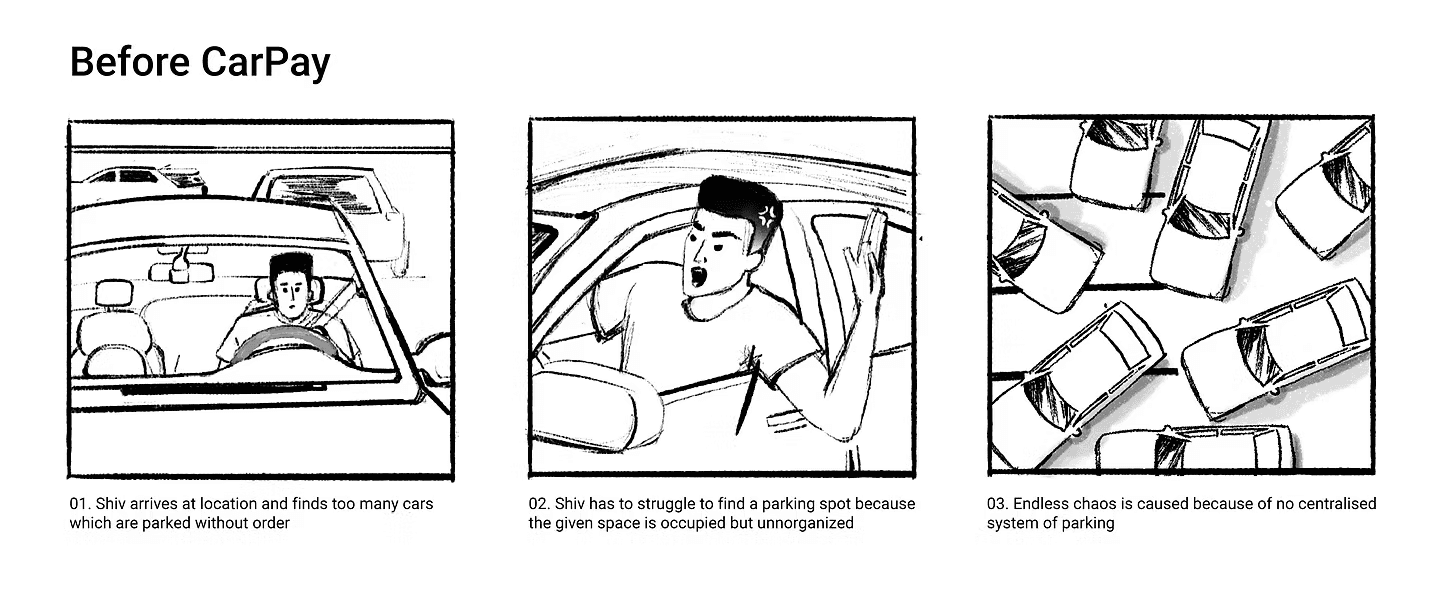
Classic before-after storyboard to highlight how we changed the overall experience.
Present Scope of Work
To study the complex parking behaviour of people and trends to derive data driven understanding of the outcomes
Provisional option to automate booking slots for regular visitors with help of ML
Tackling the problem of overcrowded parking pandemonium by strategically converting barrens lands to usable parking space for humans
How can I leverage this technological concept with appropriate business models
An online parking system that is inclusive towards specially abled personnels as well
To implement IoT and AI dependant management system that auto adjusts the meter fares based on the current occupancy
Presents Thoughts?
Did the child in me think of pitching this application to potential investors back then? Yes, but I was just a school going girl with lack of confidence and experience of the industry. Later on, similar apps came in the market? yes but it is still not fully digitalised to solve the end-to-end process of parking by an individual. Is there anymore scope for such an online portal in India? yes for sure. What about competitive analysis? Mumbai in 2018 had no such apps to study differently against a few that exist now.
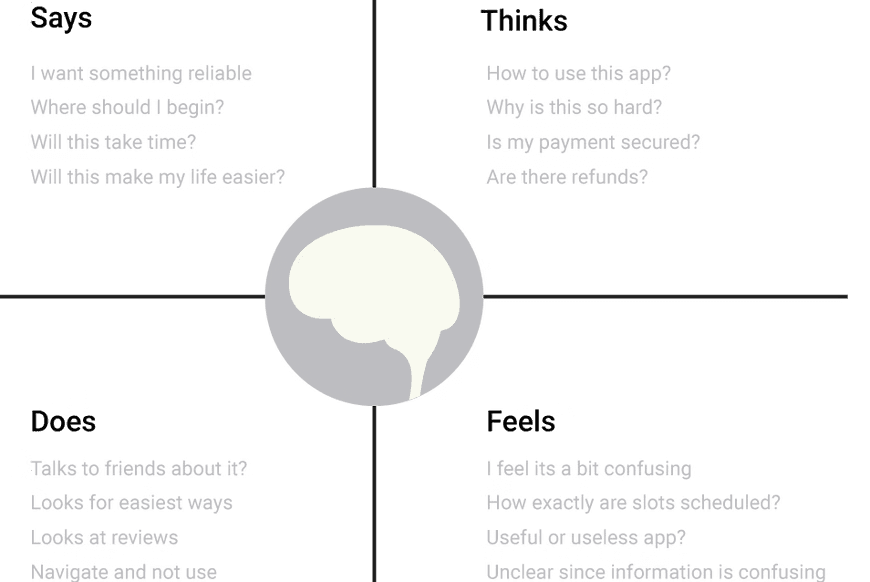
Empathy Map
Empathy Map
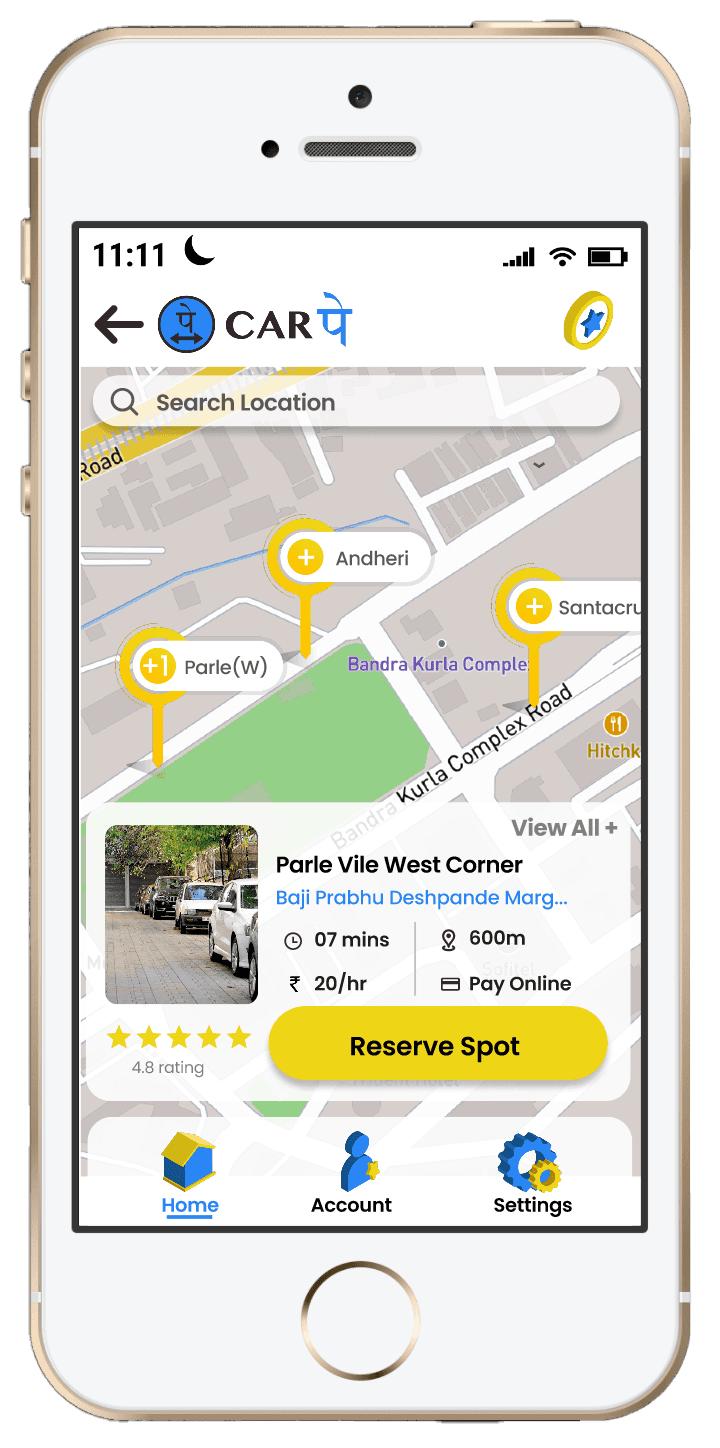
Auto detects your location
Users can choose a location where they intend to park their vehicle. The app will automatically show all the nearby parking spots
Auto detects your location
Users can choose a location where they intend to park their vehicle. The app will automatically show all the nearby parking spots
Car Pay - Smart Predictive Parking
service :
transcational UX
timeline :
feb 2018 - apr 2018
project lead
team :
role :
lead of 3
Car Pay - Smart Predictive Parking
service :
transcational UX
timeline :
feb 2018 - apr 2018
project lead
team :
lead of 3
role :
What's the parking
process really like ?
We wanted to understand how users go about when booking a parking slot online and the different decisions made along the way. We conducted a task analysis and then created a journey map.
Reflective Design
When people reflect to the parking booking experience they must feel its very 'simple' or 'easy' and hence come back to use the app again, providing the comfort and direction for daily commuters and hence solving the issue of parking chaos at large and building the revisitors database. Balsamiq low-fi wireframes were explored to guide us ahead.
Hi-fi Supporting Screens
These are some of the key design decisions I lead based mostly on the data we gathered and believing my gut as a problem solver
Despite my limited experience, this app was first designed to be fully digital, however, with my online research I deduced that monitoring can be made much stronger by embedding cameras, ultrasonic sensors and parking meters to track the timely activity of the user in real-time occupancy by the admin panel thus, full-proofing the "smart parking system design" (eg: integration of IoT-based appliance)
Hardware Speculation
Besides learning and iterating on my own, we also demonstrated the basic use of the app and got feedback from the "Traffic law reinforcement structure of MAH-Police, Mumbai, India" Some even suggested for a kiosk set-up at public hotspots to digitalise parking whereas, many agreed that an app is more convenient as waiting in kiosk queues can be very time consuming. We were reassured from our target users and experts that using smartphones to pre-book slots can ease the overcrowding situation during parking.
Design Direction
Presents Thoughts?
Did the child in me think of pitching this application to potential investors back then? Yes, but I was just a school going girl with lack of confidence and experience of the industry. Later on, similar apps came in the market? yes but it is still not fully digitalised to solve the end-to-end process of parking by an individual. Is there anymore scope for such an online portal in India? yes for sure. What about competitive analysis? Mumbai in 2018 had no such apps to study differently against a few that exist now.
My Profile
Order Confirmation
Account History
Settings
App Highlights
Driving Assistance helps the user to accurately reach the parking destination with the help of maps to locate a specific spot
Guest Login allowed for convenience
Saved History has a past archive of exact location where the vehicle was parked along with its directions. The app also saves other data such as time, vehicle model, mode of transaction, etc for users to retrace their records easily
Parallel Comparison of parking spaces along with its price and other details
CarPay's centralised management dashboard gives a comprehensive overview of all the parking lots that have been mapped under CarPay's supervision. Basic algorithm sorts the data entries by specifics such as relevance, location, driver details, vehicle model, payments, etc. The design simplicity, is intended to optimise all back - end operations.
Interface for
Admin Panel
For the initial functionality test, we used a combination of expert and user testing in order to test the functioning of our application design. We started with a list of interview questions for our potential users to probe deeper into the pain points and ended the design working with a post-task questionnaire to get an in-depth feedback on the design solution. An attempt to investigate the usability/practicality of the app, in order to get different types of feedback in terms of both quantitative and qualitative measures.
Feedback & Constructive
Criticism
User Interviewed: 5
Expert Review: 1
SUS score: 75
Preceding & Succeeding
Changes
Classic before-after storyboard to highlight how we changed the overall experience.
Present Scope of Work
To study the complex parking behaviour of people and trends to derive data driven understanding of the outcomes
Provisional option to automate booking slots for regular visitors with help of ML
Tackling the problem of overcrowded parking pandemonium by strategically converting barrens lands to usable parking space for humans
How can I leverage this technological concept with appropriate business models
An online parking system that is inclusive towards specially abled personnels as well
To implement IoT and AI dependant management system that auto adjusts the meter fares based on the current occupancy
Derived Persona
2017 marked an incredible surge of overpopulation in India which led to parking problems on a daily basis causing congestion and chaos, that one couldn't imagine. In spite, doubling the staff of traffic officials, they weren't able to control the rising traffic violence caused due to overcrowding and illegal parking.
Car Pay - Smart Predictive Parking
service :
transcational UX
timeline :
feb 2018 - apr 2018
project lead
role :
team :
lead of 3
Understanding current problem space
We conducted observations, semi-structured interviews and went on field visits to famous parking bays of Mumbai city to understand the problem space. All three of the team members visited different public parking places to get insights on the level of mayhem caused everyday. India being a developing nation, never thought of adopting a "smart parking system" till date and the concept is fairly new, even in 2026. Conduction of this project is a preliminary effort to propel more digitalisation and implementation of smart systems to enhance human parking experiences.
Auto detects your location
Users can choose a location where they intend to park their vehicle. The app will automatically show all the nearby parking spots
Enter basic details
User is redirected to online booking by filling relevant information in order to book a particular slot.
Interactive 3D map
Users can choose a location with visual ease the user can navigate available spaces on the live map and reserve a slot before making the payment. Hence, the topography of available spaces will be mapped meticulously from a top perspective and made available to users as options.
Get an E-ticket
User is redirected to online booking to encourage more users, only a minimal fee is paid online, the user will be presented with an e-ticket with all the details including parking spot location, directions and admin's phone number.
Research
Interviews
Field visits
Walkthroughs
Synthesis
Task analysis
Gathering datasets
Online resources
Brainstorming
White boarding
Group ideation
Pen/paper
Balsamiq mocks
My UX Process
Prototyping
Reiterations
Space mapping
Clearing tech jargon
Evaluation
Cognitive analysis
Benchmark tasks
SUS scale
Post-task feedback
Documentation
Report
Presentation
Showing process
Entries
Insights Formed
Derived Persona
What's the parking process really like ?
We wanted to understand how users go about when booking a parking slot online and the different decisions made along the way. We conducted a task analysis and then created a journey map.
Finding key user needs
We analysed our separate notes from all the previous formative research on an affinity diagram. This helped us segregate our findings to identify key user needs.
I don't want to wait in long congestion queues for a simple parking
I'm having trouble in locating my car since so much haphazard parking
I wish there is a quicker way to reach my destination to straight parking
Brainstorming
We were struggling with how to narrow down details for end-to-end process of parking experience. We wanted to eliminate unpredictability that one faces while online booking. That's when I worked on the feasibility vs user-impact chart which helped us derive conclusions for the next steps. We wanted a way where we could maximise the benefits for the user but also keep it very simple for the providers to encourage them to adopt the system.
Information Architecture
Visceral Design
Designs that follow mental models, for people to instinctively and intuitively navigate through the app making parking available through least number of taps (Note: that people in the 21st century have a good amount of experience with operating mobile apps). CarPay's primary iconography consists of "3D graphic icons" inspired by historically carved road-signages to imbibe a welcoming and an understandable appeal. The app also uses a combination of contrasting colours "yellow and blue" signifying the "availability of parking spaces" while evoking a sense of safety and harmony at the same time. The type family used is "Poppins" for clear visibility along with writing its UX copy.
Empathy Map
Reflective Design
When people reflect to the parking booking experience they must feel its very 'simple' or 'easy' and hence come back to use the app again, providing the comfort and direction for daily commuters and hence solving the issue of parking chaos at large and building the revisitors database. Balsamiq low-fi wireframes were explored to guide us ahead.
Hi-fi Supporting Screens
These are some of the key design decisions I lead based mostly on the data we gathered and believing my gut as a problem solver
My Profile
Order Confirmation
Account History
Settings
App Highlights
Interface for Admin Panel
Driving Assistance helps the user to accurately reach the parking destination with the help of maps to locate a specific spot
Guest Login allowed for convenience
Saved History has a past archive of exact location where the vehicle was parked along with its directions. The app also saves other data such as time, vehicle model, mode of transaction, etc for users to retrace their records easily
Parallel Comparison of parking spaces along with its price and other details
CarPay's centralised management dashboard gives a comprehensive overview of all the parking lots that have been mapped under CarPay's supervision. Basic algorithm sorts the data entries by specifics such as relevance, location, driver details, vehicle model, payments, etc. The design simplicity, is intended to optimise all back - end operations
(the administrative interface maintains a more plain and a formal visual tone dissimilar to the mobile app since both cater to differently)
CarPay's centralised management dashboard gives a comprehensive overview of all the parking lots that have been mapped under CarPay's supervision. Basic algorithm sorts the data entries by specifics such as relevance, location, driver details, vehicle model, payments, etc. The design simplicity, is intended to optimise all back - end operations
(the administrative interface maintains a more plain and a formal visual tone dissimilar to the mobile app since both cater to differently)
Admin Features Aiding Management
Despite my limited experience, this app was first designed to be fully digital, however, with my online research I deduced that monitoring can be made much stronger by embedding cameras, ultrasonic sensors and parking meters to track the timely activity of the user in real-time occupancy by the admin panel thus, full-proofing the "smart parking system design" (eg: integration of IoT-based appliance)
Hardware Speculation
Design Direction
Besides learning and iterating on my own, we also demonstrated the basic use of the app and got feedback from the "Traffic law reinforcement structure of MAH-Police, Mumbai, India" Some even suggested for a kiosk set-up at public hotspots to digitalise parking whereas, many agreed that an app is more convenient as waiting in kiosk queues can be very time consuming. We were reassured from our target users and experts that using smartphones to pre-book slots can ease the overcrowding situation during parking.
Feedback & Constructive Criticism
User Interviewed: 5
Expert Review: 1
For the initial functionality test, we used a combination of expert and user testing in order to test the functioning of our application design. We started with a list of interview questions for our potential users to probe deeper into the pain points and ended the design working with a post-task questionnaire to get an in-depth feedback on the design solution. An attempt to investigate the usability/practicality of the app, in order to get different types of feedback in terms of both quantitative and qualitative measures.
SUS score: 75
Preceding & Succeeding Changes
Classic before-after storyboard to highlight how we changed the overall experience.
Present Scope of Work
To study the complex parking behaviour of people and trends to derive data driven understanding of the outcomes
Provisional option to automate booking slots for regular visitors with help of ML
Tackling the problem of overcrowded parking pandemonium by strategically converting barrens lands to usable parking space for humans
How can I leverage this technological concept with appropriate business models
An online parking system that is inclusive towards specially abled personnels as well
To implement IoT and AI dependant management system that auto adjusts the meter fares based on the current occupancy
Presents Thoughts?
Did the child in me think of pitching this application to potential investors back then? Yes, but I was just a school going girl with lack of confidence and experience of the industry. Later on, similar apps came in the market? yes but it is still not fully digitalised to solve the end-to-end process of parking by an individual. Is there anymore scope for such an online portal in India? yes for sure. What about competitive analysis? Mumbai in 2018 had no such apps to study differently against a few that exist now.