" height="18.488377445339474px" id="PmGl9mmDY" transform="translate(3 1)" width="15.443520457704416px"/><path d="M 7.321 19 C 6.201 19 5.19 18.847 4.287 18.539 C 3.43 18.254 2.643 17.795 1.975 17.192 C 1.332 16.592 0.831 15.858 0.508 15.043 C 0.158 14.125 -0.014 13.15 0.001 12.17 L 0.001 12.135 L 5.243 12.135 L 5.243 12.161 C 5.243 12.646 5.324 13.062 5.487 13.403 C 5.65 13.744 5.884 14.004 6.186 14.183 C 6.507 14.368 6.873 14.461 7.243 14.452 C 7.854 14.452 8.314 14.264 8.625 13.89 C 8.944 13.506 9.103 12.95 9.103 12.224 L 9.103 0 L 14.576 0 L 14.576 12.259 C 14.576 13.687 14.292 14.905 13.726 15.911 C 13.158 16.911 12.292 17.713 11.247 18.206 C 10.17 18.733 8.861 18.998 7.321 18.998 Z" fill="rgb(255, 255, 255)" height="19px" id="KYO9BColy" transform="translate(18.424 1)" width="14.576310124684067px"/></svg>)
What if rebuilding history could help us remember it better?
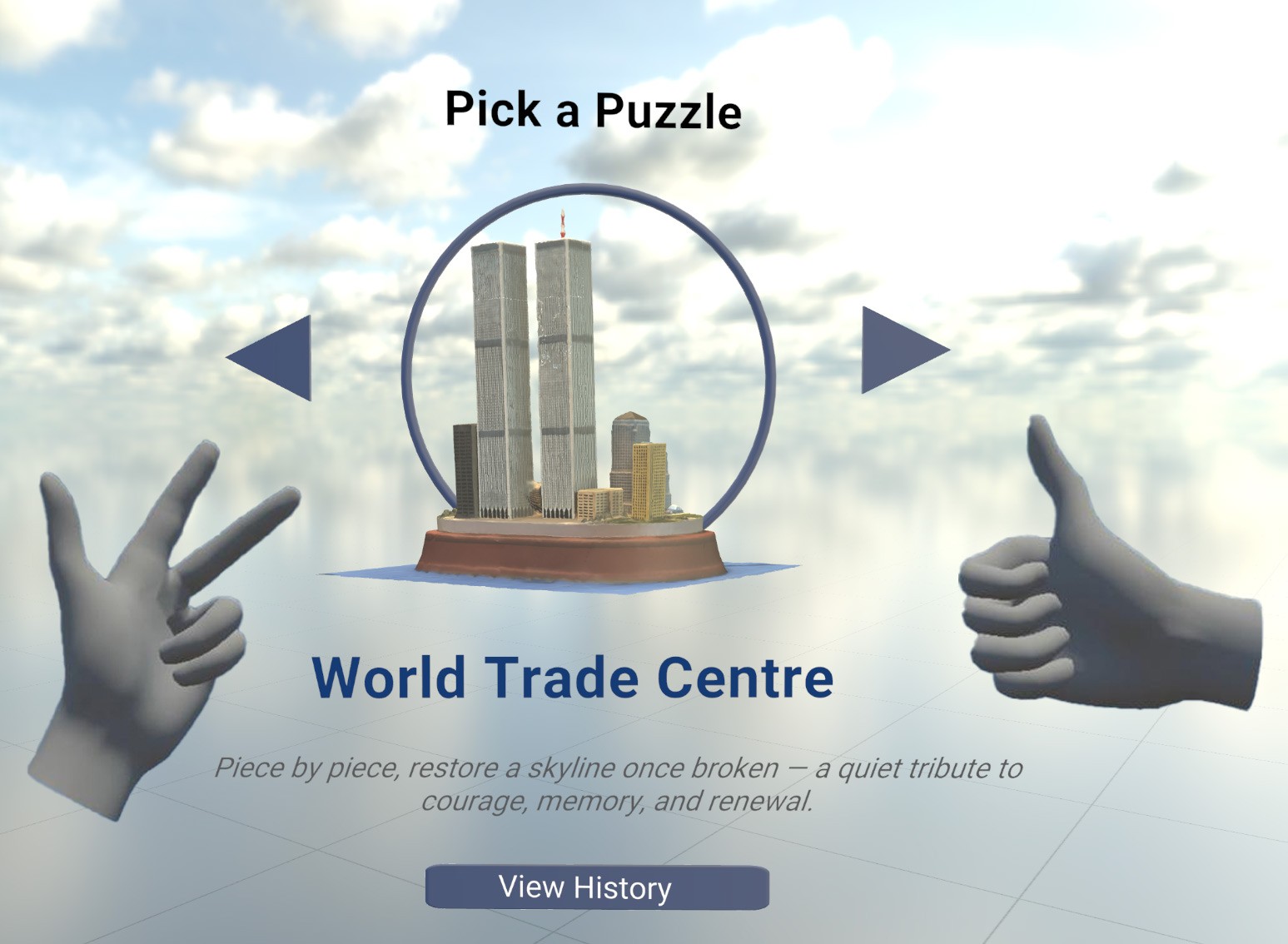
Rebuild NYC is an immersive VR experience where users reconstruct iconic New York landmarks in 3D space while an adaptive narrative engine responds to their behavior in real time.This project explores how embodied cognition, spatial interaction, and AI-driven storytelling can increase engagement and knowledge retention compared to passive museum experien
5
Project Details
Project:
XR Product Developer | UX Architect | Interaction Designer
Timeline:
Oct 2025 - Nov 2025 (Production-ready MVP)
Status:
Unity3D, XR Interaction Toolkit, Meta Quest 3, C#
Mentors:
Prof. Lisa Lokshina
Overview
Museums and digital learning platforms often rely on passive consumption: plaques, flat screens, audio guides. Retention is low. Emotional engagement is shallow.
Interaction is minimal.
Opportunity:
Can spatial computing transform historical learning from passive observation into active reconstruction?
An Adaptive Spatial Learning Platform Built for
the Future of Immersive Computing
The Product Vision
Transform users from observers into rebuilders.
By physically reconstructing fragmented landmarks, users:
• Engage motor memory
• Activate spatial reasoning
• Experience contextual storytelling
• Build emotional connection
This aligns with research in embodied cognition, which suggests physical interaction increases memory encoding.
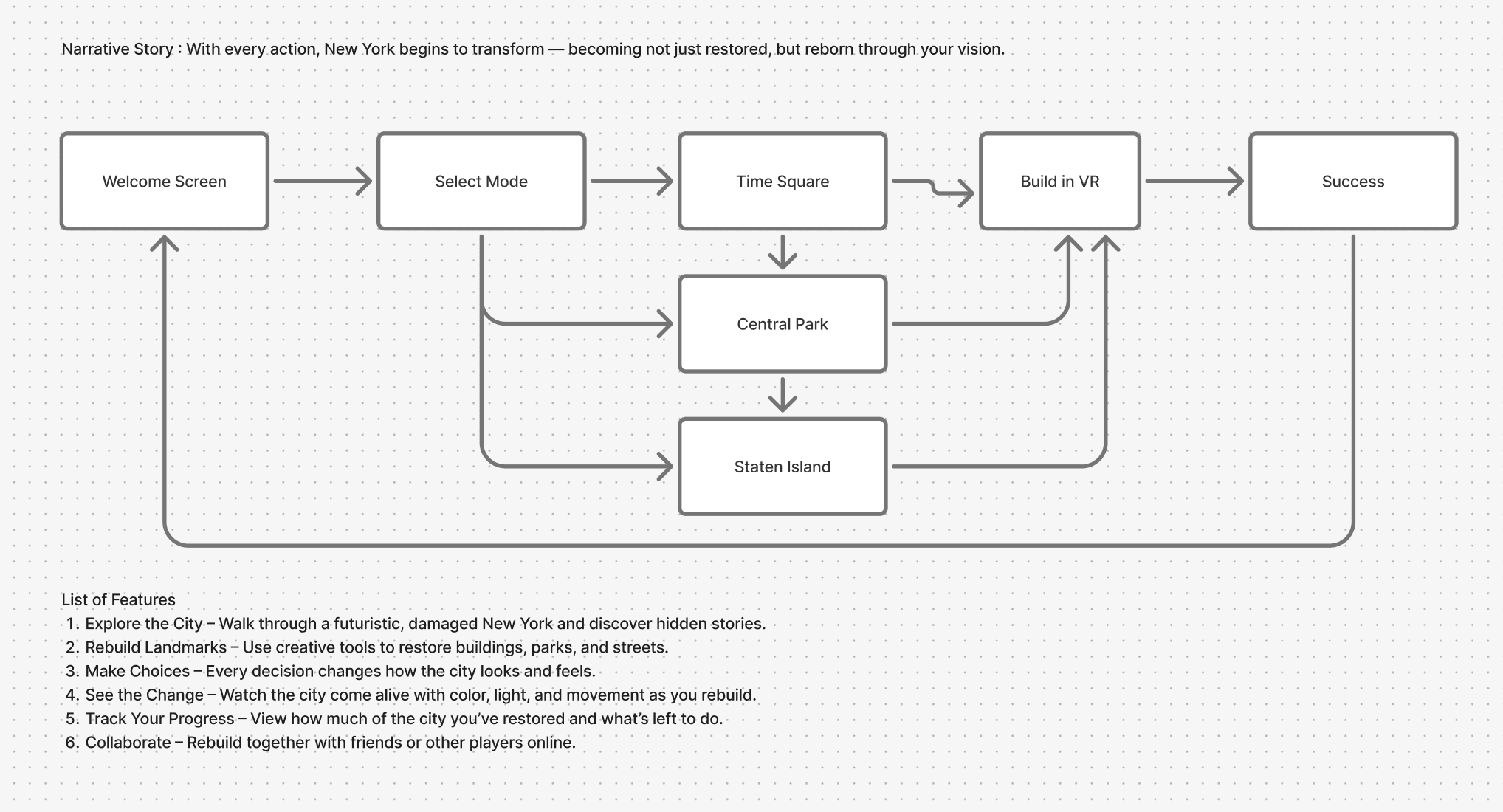
Core Experience Design
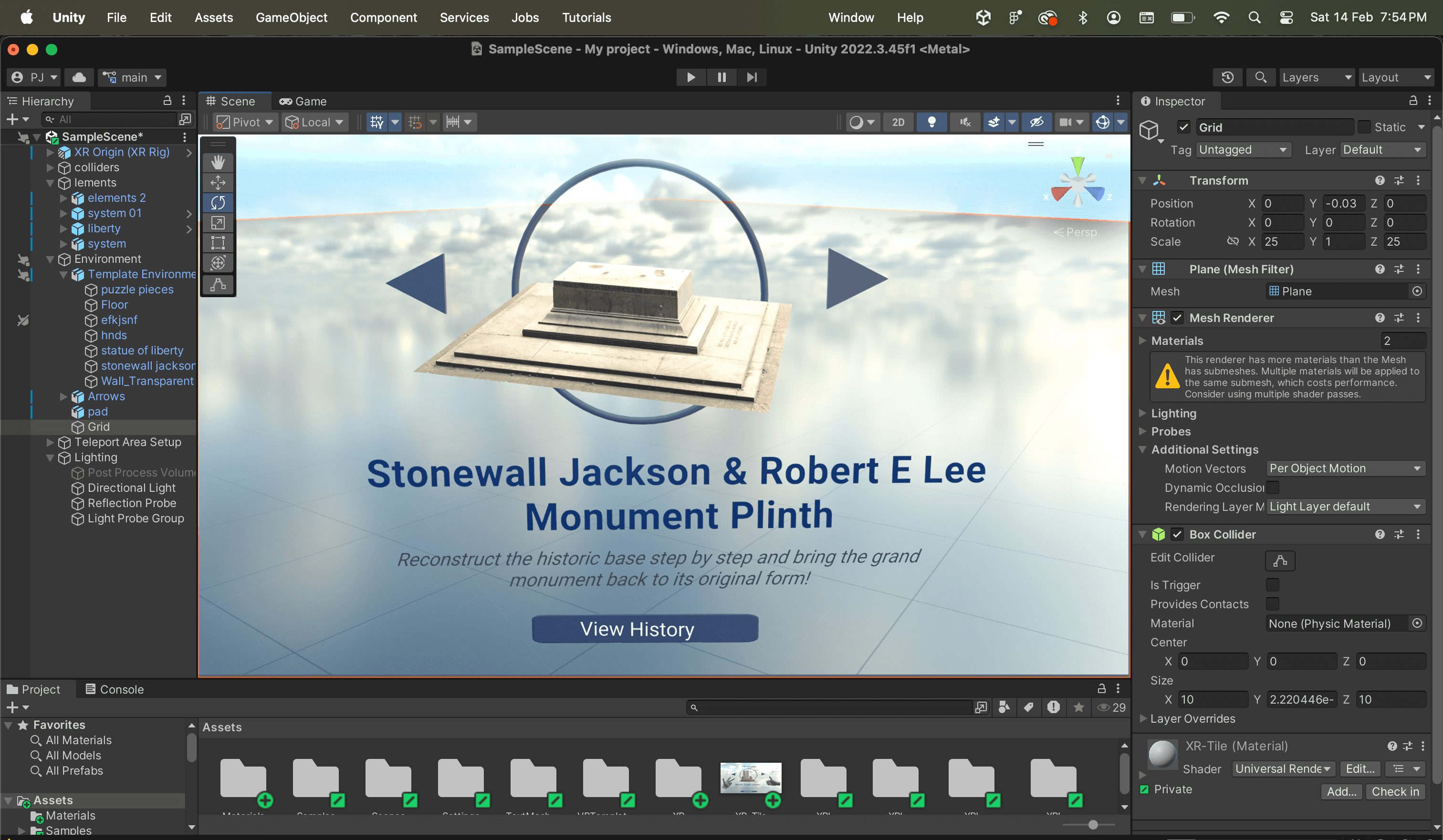
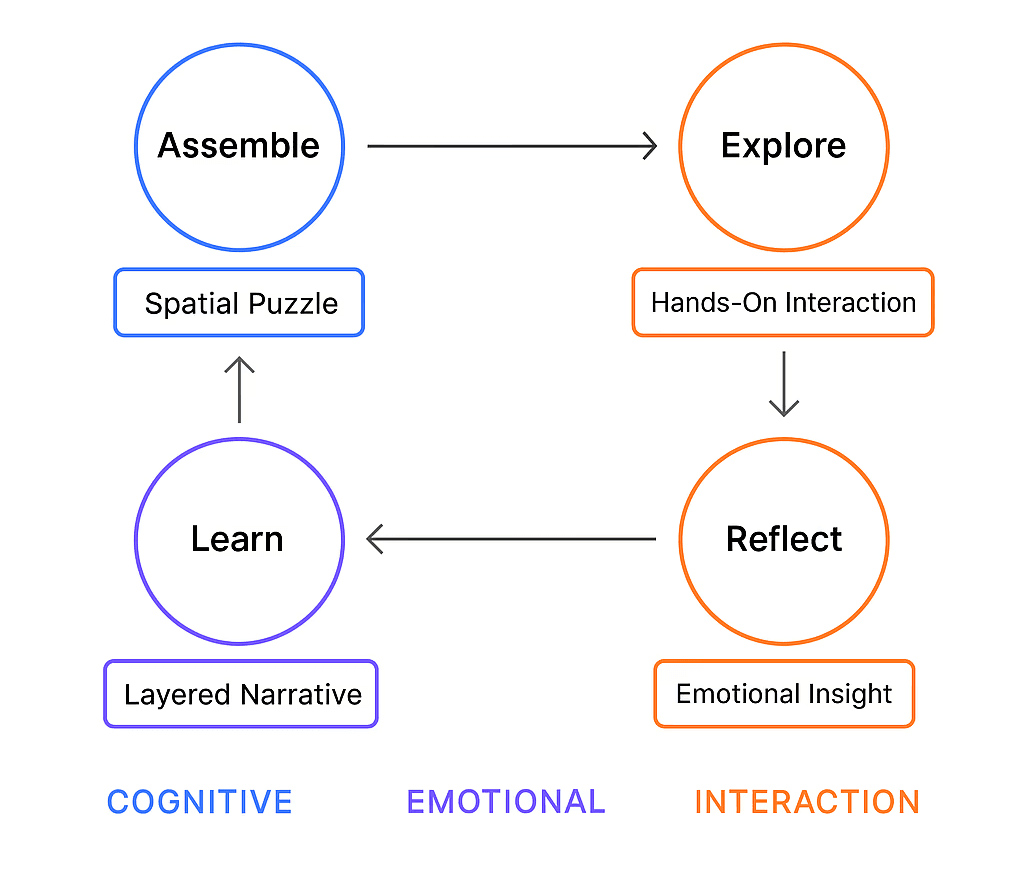
I designed a modular interaction system built around 6DOF spatial alignment.
User grabs a monument fragment using physics-based interaction
Inspects geometry and spatial cues
Aligns fragment in 3D space
Correct placement triggers contextual narrative
System adapts difficulty and storytelling depth
This loop was optimized for cognitive flow and reduced friction in VR interaction.
Adaptive Narrative System
Instead of linear storytelling, I built a behavior-responsive narrative engine. The system tracks:
• Time to placement
• Alignment accuracy
• Exploration behavior
• Idle time
Based on this, the experience dynamically adjusts narrative tone and depth. Fast users receive architectural insights. Exploratory users receive cultural and emotional context. This was implemented using a rule-based state engine with scalable reinforcement-learning logic.
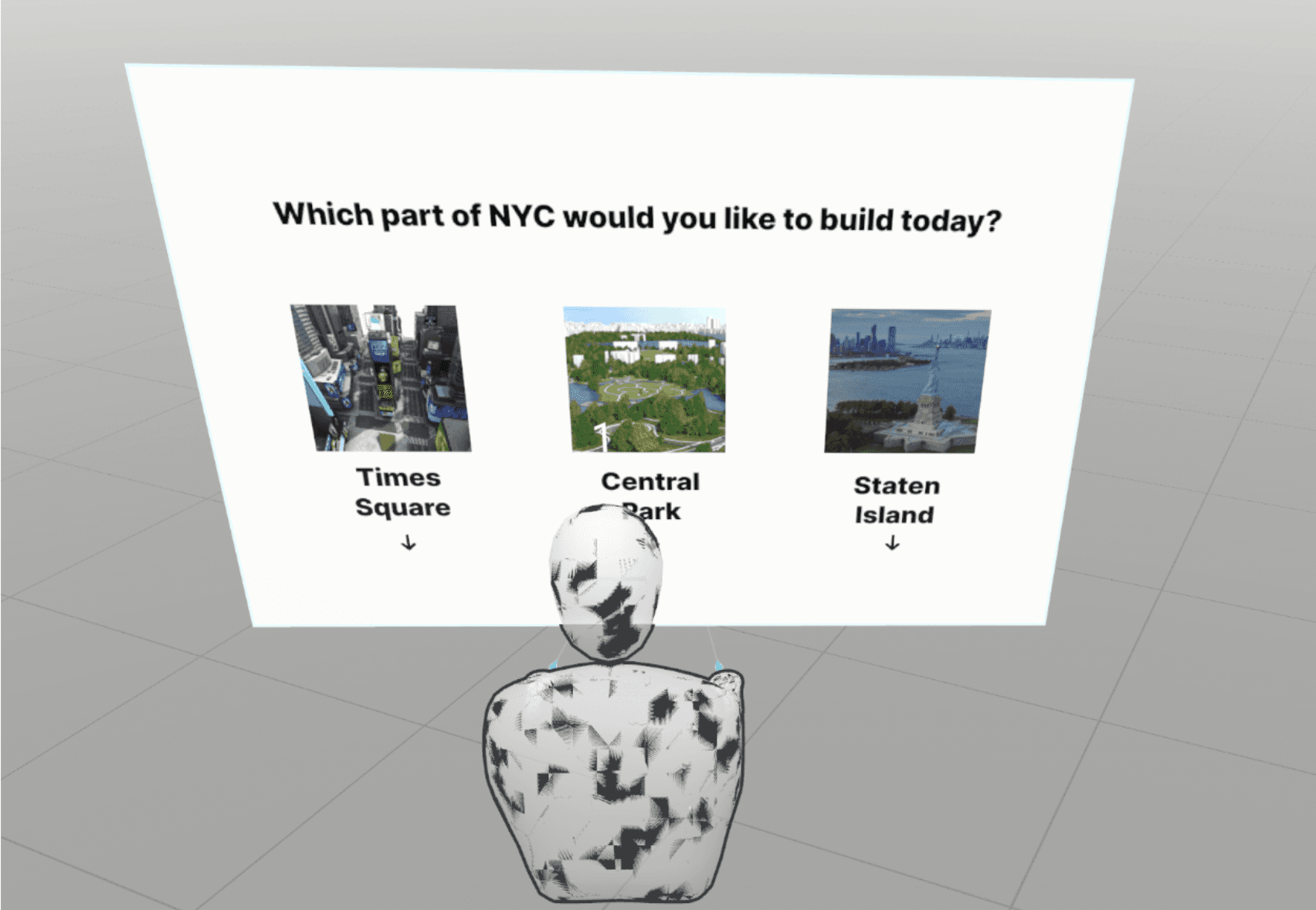
Interaction & UX Architecture: Spatial UI Strategy
Rookie Mistakes: Flat menus break immersion in XR. I replaced traditional UI with:
• Holographic radial menu anchored to non-dominant hand
• Gaze-assisted highlighting
• Color-coded alignment feedback
• Spatial adjustable audio guidance
Design decisions were guided by XR ergonomics and arm fatigue studies.
Usability Testing
Tested with 10 users (VR and non-VR backgrounds) - Quantitative Results
• 82% puzzle completion without guidance
• 28% faster task performance after 5 minutes
• 40% improvement in historical recall
Qualitative Feedback
“It feels like I’m holding history.”
“The story responding to how I build makes it feel alive.”
Got a project in mind? Tell me about it
Hi, I’m Priyam Joshi, a Designer who turns curiosity into meaningful experiences. I bridge human emotion, technology, and strategy to craft experiences that don’t just look good they work beautifully. As a UX Designer and Researcher, my passion lies in uncovering the “why” behind user behavior and transforming insights into inclusive, data-driven design systems that create real business impact.